Why it exists
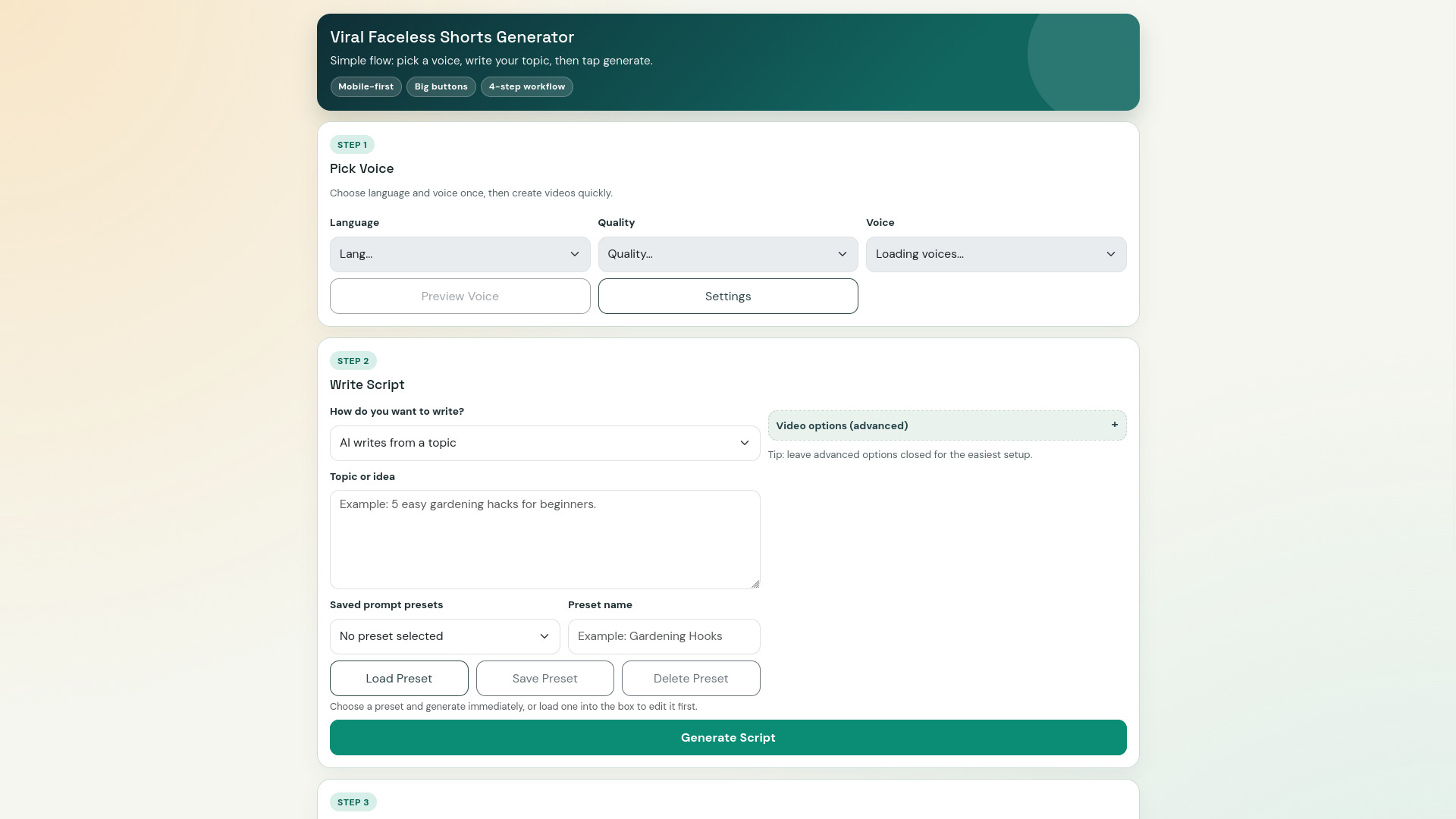
The project explores how far an automated content pipeline can go while still keeping human control before final rendering. It is not just a video generator: it is an orchestration experiment that connects trend detection, script generation, voice synthesis, forced alignment and video composition.
Project media
Architecture
- A web interface lets the user choose a Google Trends category, custom topic or custom prompt.
- A Gemini-powered service generates title, description and script.
- The script is manually reviewed and optionally edited before rendering.
- Piper TTS generates the voice track.
- Aeneas aligns subtitles with the produced speech.
- FFmpeg combines background footage, voiceover and subtitles into the final video.
- Nginx fronts the web interface and reverse proxies the internal services.
Key features
- Trending topic detection via Google Trends.
- Prompt-based script generation.
- Manual approval before rendering.
- TTS with Piper.
- Forced subtitle alignment with Aeneas.
- Selectable output orientation.
- SQLite-backed settings and configurable server-side output folder.
Design decisions
The most important design choice is the human-in-the-loop step. Rendering starts only after the generated script is approved, which makes the pipeline safer, more controllable and more useful than a fully blind generator.